
The Human Voice At The Centre Of Brain–Body Adaptation
Voice Brain Science is the research section of Regeneration & Sonor. It explores how real human voice, acoustic waves, neural signals, and bodily responses can work together.
Research-Led · Human-Centred · Medically Responsible
A Real Human Need
A few numbers are enough to show the scale of voice, communication, movement, and neurological loss.
New Strokes Each Year
Behind the number are people who may suddenly lose speech, movement, response, or independence.
Lifetime Stroke Risk
Neurological loss is not a distant or isolated problem.
Aphasia After Stroke
A person may still think clearly while losing the natural ability to speak or understand.
Living With Parkinson’s
Voice, movement, swallowing, timing, and bodily response may progressively change.
Many Human Functions
Command, identity, warning, response, emotion, recognition, and connection.
Rounded global figures. Scientific sources include WHO, World Stroke Organization, and peer-reviewed neurological research.
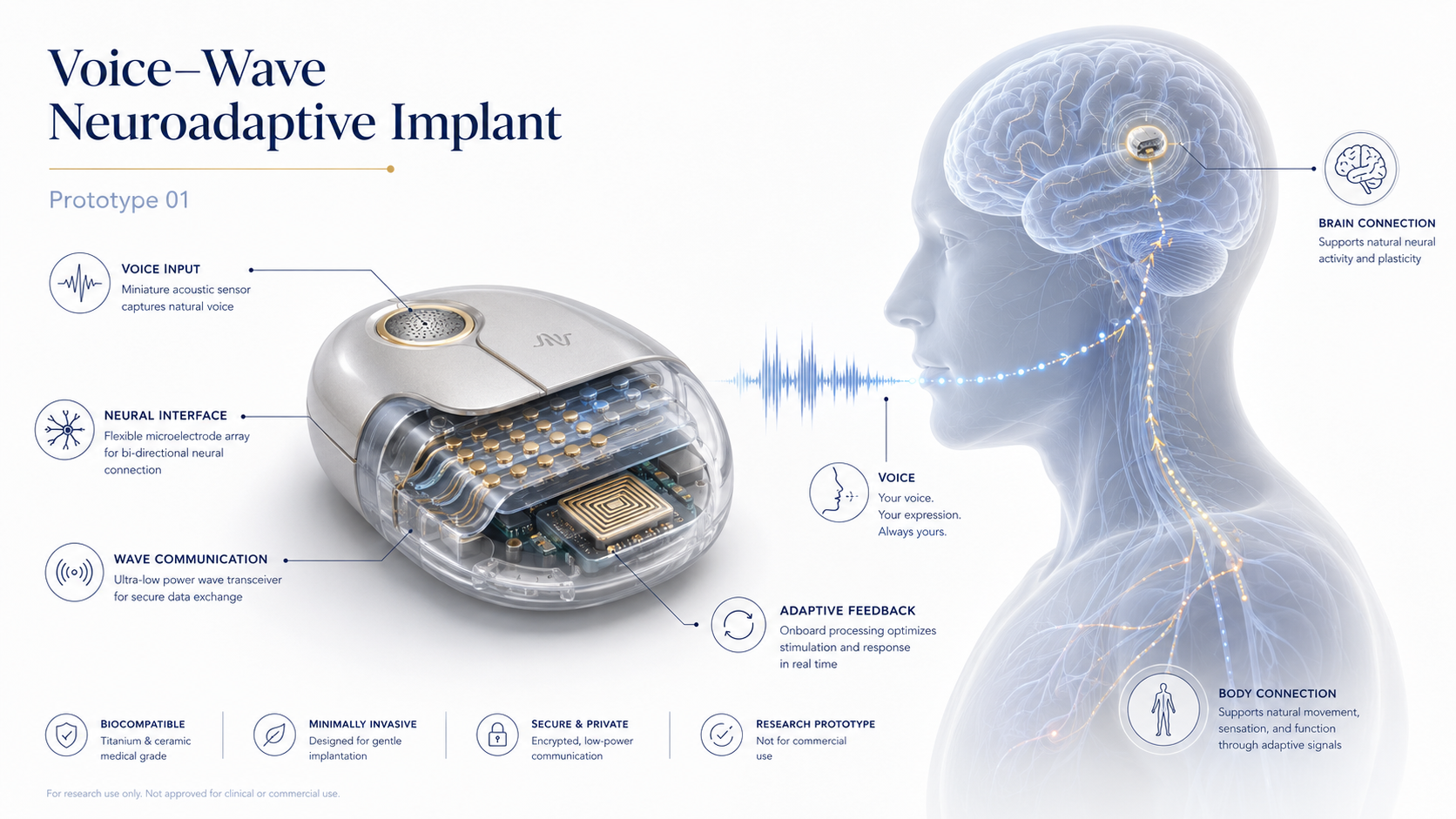
Voice–Wave Neuroadaptive Implant
A proposed miniature hybrid system centred on the person’s real voice.
Receive
Voice, neural intention, and bodily signals.
Interpret
Connections between voice, brain, and response.
Adapt
Changes in voice, fatigue, movement, and condition.
Support
Controlled voice, acoustic, or neural assistance.
Return
Useful feedback to the person and care system.
One Direction. Multiple Possibilities.
Numbers make the research structure immediately visible.
Signal Layers
Human Voice · Neural Activity · Bodily Response
Initial Human Profiles
Residual Voice · Preserved Intention · Impaired Response
Moments Of Support
Detection · Rehabilitation · Adaptation · Long-Term Support
Research Stages
Foundation to regulated clinical feasibility.
What Will Be Measured?
The value of the research must appear in observable results.
Commands Detected
How many intended commands are correctly identified?
Commands Missed
How much human intention remains undetected?
False Activations
How often does the system respond without intention?
Response Time
How quickly does intention become supported action?
Residual Voice
How much useful information remains in a weakened voice?
Independent Action
How many actions can the person complete with less assistance?
The Human Must Remain Present
The technology is not designed to replace thought, voice, choice, clinicians, caregivers, or human relationships.
Its purpose is to detect what remains possible and support what has become weakened.
Research Collaboration
Connecting neuroscience, neurology, voice science, acoustics, biomedical engineering, rehabilitation, and human-centred technology.
Contact Voice Brain Science